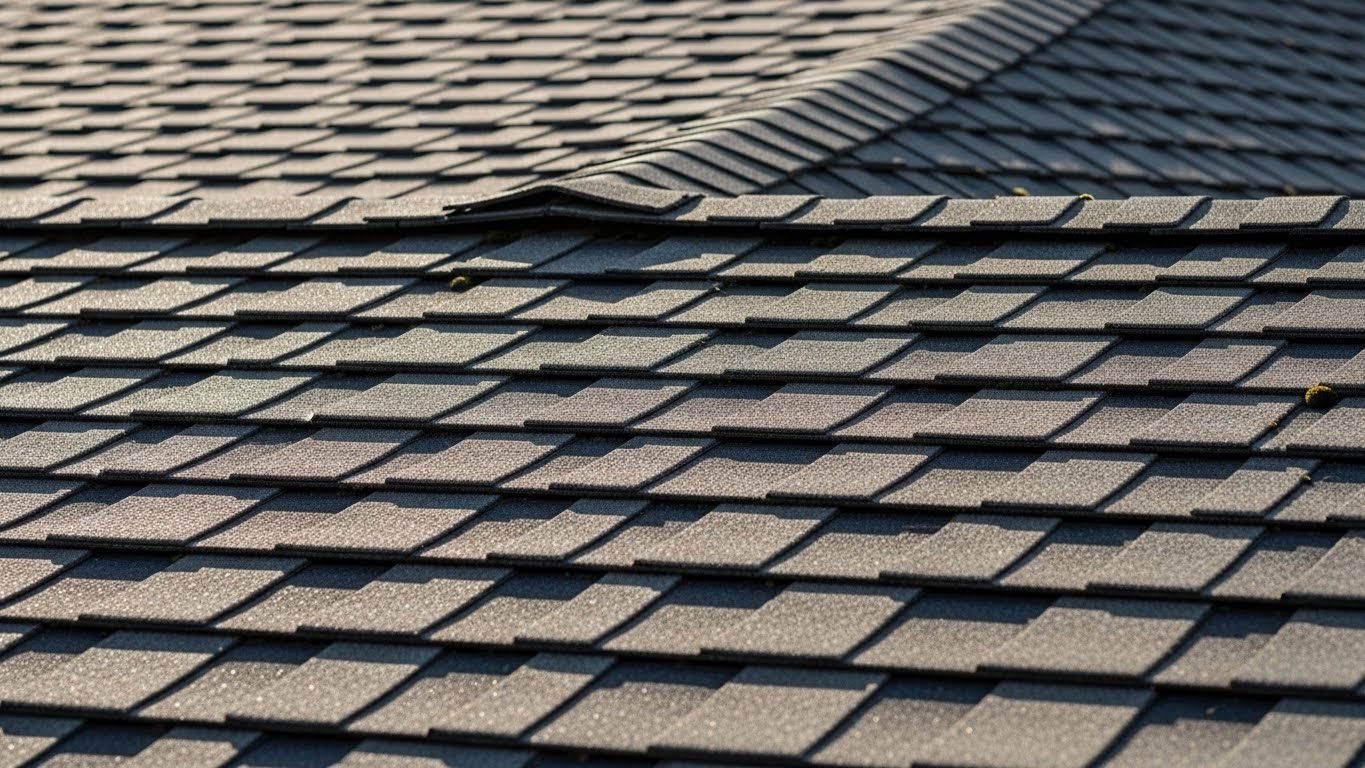
Yes, architectural shingles can crease from wind. Not always. Not instantly. But it happens often enough that roofers recognize it the moment they see it. The crease itself is not dramatic like a shingle flying off. It is quieter than that. A bend that never quite straightens again.
Wind does not need to be hurricane level either. Repeated uplift, short violent gusts, pressure changes under the shingle tabs, all of it adds up over time. Creasing is usually the early warning sign, not the final failure.
What a wind crease actually looks like
A wind crease is a visible horizontal or slightly diagonal line across the shingle. It often appears just above the adhesive strip. The shingle looks bent, like cardboard folded once and then released. Even when the shingle lays flat again, the crease remains.
From the ground, it may look like a shadow or dirt line. Up close, you can feel it. The granules may still be there. The shingle is not torn. But the fiberglass mat inside has been stressed. That damage does not heal.
Architectural shingles (also known as dimensional or laminated shingles) and 3-tab shingles are both made from asphalt and serve the same fundamental purpose: protecting your home from the elements. But they differ significantly in design, durability, and performance.
https://www.homefix.com/posts/architectural-shingles-vs-3-tab-asphalt
Why architectural shingles crease more than people expect
Architectural shingles are thicker than old three tab shingles. That thickness gives weight and durability, but it also means more surface area for wind to grab. Each layer creates a small air pocket. When wind gets underneath, it lifts the shingle slightly, then slams it back down.
This repeated flexing causes the crease. Especially when shingles are new and stiff, or old and brittle. Either extreme makes them more vulnerable.
Wind speed matters, but not the way most think
Many homeowners assume creasing only happens during extreme storms. Data from insurance adjuster reports and roofing inspections show otherwise. Wind speeds in the 40 to 60 mph range are often enough to start the process. These are not rare events in many regions.
Short bursts are worse than steady wind. Gusts create uplift. That uplift breaks the adhesive seal temporarily. Once that seal weakens, the shingle moves more freely next time.
Installation plays a bigger role than marketing claims
Architectural shingles are often advertised with wind ratings of 110 mph or higher. Those ratings assume perfect installation. Correct nailing. Proper seal activation. Adequate attic ventilation.
If nails are placed too high, the shingle hinge point changes. That increases flex. If the adhesive strip does not bond fully due to cold weather installation, dust, or moisture, the shingle becomes easier to lift. Creasing follows.
Most wind creases traced during inspections are not product defects. They are installation related, even if no one wants to hear that.
Temperature swings make creasing worse
Asphalt shingles expand and contract. In regions with wide temperature swings, the shingle mat is already under stress. Add wind flexing to that, and the fiberglass reinforcement starts to fatigue.
Cold weather makes shingles rigid. Wind hits harder then. Hot weather softens them. Wind stretches them more. Neither condition is ideal. Over years, the stress leaves a visible mark.
Is a creased shingle automatically a failed shingle
Not immediately. A crease does not always mean active leaking. But it is a weak point. Water flows differently over a bent surface. Granule loss often accelerates along the crease line. UV exposure works faster there.
Roofers often describe creased shingles as compromised. They may still shed water today. Their lifespan is reduced though. Think of it as a crack in the armor, not a hole yet.
How inspectors and adjusters view wind creasing
This is where things get tense. Insurance adjusters often argue that creasing alone does not equal functional damage. Contractors argue that it does, because it alters the shingle structure.
Industry inspection standards often land in the middle. A few isolated creases may be noted but not approved for replacement. Widespread creasing across multiple slopes is more likely to be considered wind damage.
Context matters. Age of roof. Pattern of creases. Direction relative to prevailing winds. Inspectors look at all of it.
Can architectural shingles recover after wind
No. Once creased, they do not uncrease. Heat may flatten them visually, but the internal mat remains damaged. The shingle remembers the bend, even if your eyes forget it for a while.
That is why creasing often shows up again after the next windy day. The weakness is already there.
Reducing the risk of wind creasing
Proper installation reduces most problems. Correct nail placement. Adequate nails per shingle. Installing during recommended temperature ranges. Ensuring clean surfaces for adhesive sealing.
Good attic ventilation also matters more than people realize. Pressure imbalance inside the attic increases uplift forces. Balanced intake and exhaust reduce that invisible push from below.
Final notes
Architectural shingles are durable, but they are not immune to physics. Wind finds weaknesses. Sometimes slowly, sometimes all at once. Creasing is the subtle signal that the roof has been working harder than it should.
Ignoring it does not always cause immediate failure. But understanding it helps homeowners make better decisions. Whether that means closer monitoring, selective repairs, or planning ahead for replacement. Roofs rarely fail without leaving clues. Creases are one of the quieter ones.