
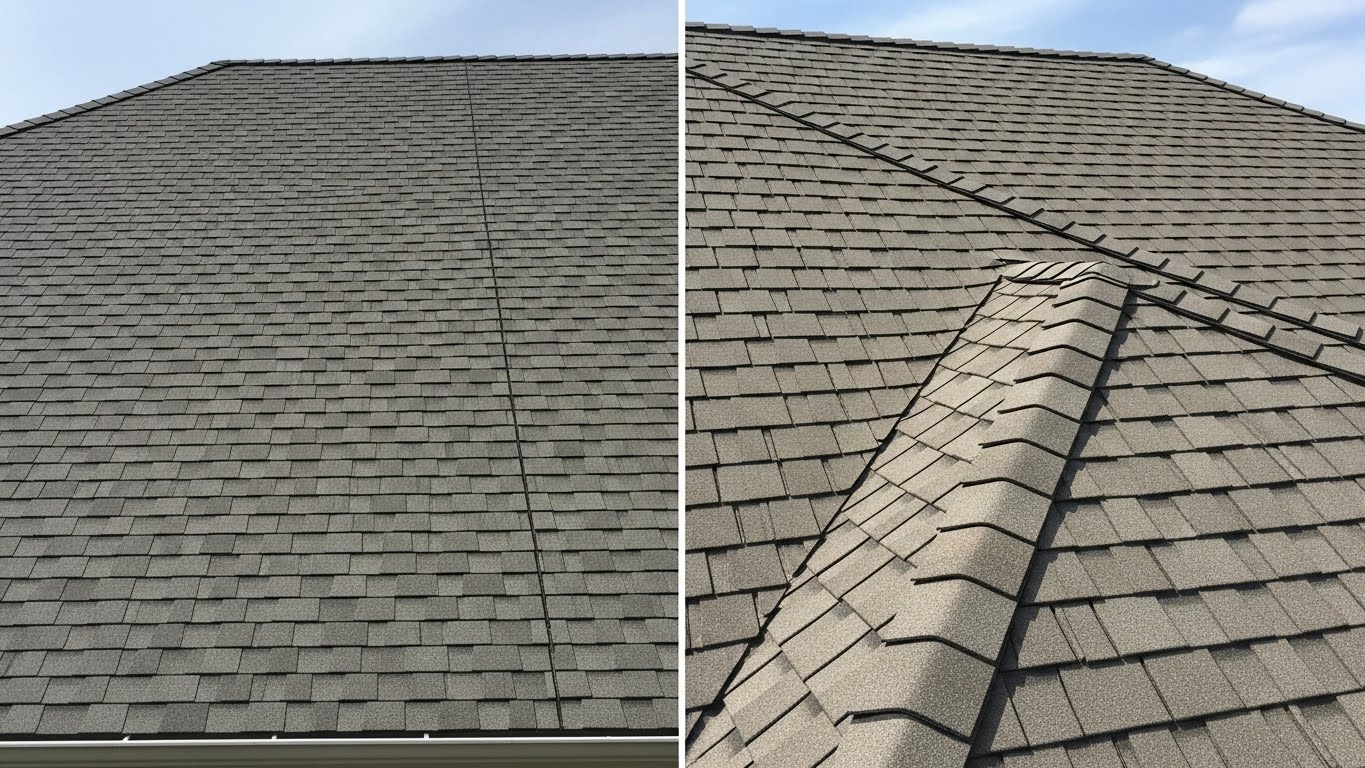
Choosing roofing shingles feels straightforward until you start reading specs, warranties, and contractor opinions that slightly disagree with each other. Asphalt shingles and architectural shingles sit in the same family, yet behave very differently once they are on a roof for ten or twenty years. The difference is not just visual, it shows up in wind resistance, aging patterns, repair cycles, and how often homeowners end up calling a roofer again. This article breaks it down carefully, but without pretending the choice is always obvious.
What people usually mean by asphalt shingles
And why that wording causes confusion
When people say asphalt shingles, they usually mean traditional 3 tab shingles. These are flat, single layer shingles made from an asphalt saturated fiberglass mat with mineral granules on top. They are uniform in size and shape, and when installed, the roof looks very clean, almost grid like from above.
3 tab shingles became dominant in North America after World War II because they were affordable, easy to transport, and fast to install. Even today, industry shipment data still shows asphalt shingles as covering roughly 70 to 75 percent of residential roofs in the US, with 3 tab making up a shrinking but still meaningful portion of that number.
They are lightweight, typically around 190 to 210 pounds per roofing square, which matters on older structures. Contractors also like them because repairs are simple. One damaged shingle can often be swapped without disturbing the surrounding area too much, though that does not always look perfect later.
What architectural shingles actually are
Not just thicker, and not just cosmetic
Architectural shingles, sometimes called dimensional or laminated shingles, are still asphalt based. The key difference is layering. Instead of one flat piece, multiple layers of asphalt bonded together create depth and irregular edges. That layered build changes how the shingle reacts to wind, heat, and impact.
Architectural shingles usually weigh between 240 and 320 pounds per square, depending on the product line. That extra mass is not decorative only. It increases tear resistance and helps the shingle sit flatter during high wind events. Many architectural shingles carry wind ratings of 110 to 130 mph when installed with proper nailing patterns, while standard 3 tab shingles are commonly rated around 60 to 70 mph.
This does not mean architectural shingles never fail in storms. It just means they fail differently and usually later.
Lifespan expectations
What manufacturers say versus what roofs actually experience
Manufacturer warranties often create unrealistic expectations. 3 tab shingles are commonly sold with 20 to 25 year warranties. Architectural shingles are marketed with 30 year, 40 year, or even lifetime warranties. In practice, real world lifespan is shorter for both, but the gap between them still exists.
Field studies from insurance claim data and roofing inspection records suggest average service life looks more like this:
3 tab asphalt shingles often last 15 to 18 years in moderate climates, sometimes less in areas with strong sun or frequent hail.
Architectural shingles often reach 22 to 30 years under similar conditions, assuming ventilation is decent and installation was not rushed.
Heat cycling plays a huge role here. Thicker shingles cool and heat more slowly, which reduces cracking around nail lines over time. That alone explains a lot of the lifespan difference.
Wind performance and storm behavior
Why thickness and shape really matter
Wind does not just lift shingles straight up. It gets under edges, pushes sideways, and creates pressure differences across the roof plane. Flat shingles with uniform tabs offer predictable lift points. Once one tab peels, adjacent tabs are exposed fast.
Architectural shingles interrupt airflow. Their uneven edges and layered faces break wind paths. This reduces uplift force on any single point. Insurance loss data after major wind events repeatedly shows fewer partial roof failures on architectural shingle roofs compared to 3 tab roofs of similar age.
This does not make architectural shingles storm proof. Poor nailing, reused flashing, or weak decking will still fail first. But all else equal, architectural shingles give more margin before damage starts.
Appearance over time
How roofs age, not how they look on day one
New 3 tab shingles look clean and sharp. After several years, granule loss becomes obvious because the surface is flat and uniform. Any discoloration stands out. Repairs also stand out more, since replacement shingles rarely match sun faded originals.
Architectural shingles hide aging better. The layered shadows mask color variation. Minor granule loss blends into the texture. Even mismatched repairs tend to be less noticeable from ground level, which matters more than people admit.
Home appraisal data often reflects this. Roofs with architectural shingles tend to retain curb appeal longer, even when both roofs are technically aging at the same rate.
Cost differences
Upfront price versus long ownership math
Material costs vary by region, but averages stay fairly consistent nationwide. As of recent industry pricing surveys:
3 tab asphalt shingles often cost 20 to 30 percent less per square than architectural shingles.
Labor cost difference is usually small, since installation time is similar.
Where the math changes is replacement timing. If a homeowner plans to stay in a house for more than 15 years, architectural shingles often cost less over the full ownership period, even with higher upfront expense. Short term owners sometimes choose 3 tab shingles because resale may happen before aging becomes obvious.
That choice is not wrong, just situational.
Weight and structural considerations
A detail people forget to ask about
Architectural shingles add weight. On modern homes, this is rarely an issue. On older homes, especially those built before modern decking standards, roof load should be evaluated. One extra layer of architectural shingles installed over an existing roof can push structures close to load limits.
Most building codes limit asphalt shingle roofs to two layers, but that does not mean two layers are always wise. Tear off costs more, yet it reduces long term stress on framing and decking.
Maintenance and repair reality
What roofers actually see years later
3 tab shingles are easier to replace individually, but they fail more frequently. Architectural shingles fail less often, but repairs can be trickier because layers interlock visually. Poor repairs on architectural roofs can look messy if rushed.
Algae streaking affects both types, though thicker shingles sometimes dry slower, which can slightly increase streaking in humid regions. Algae resistant granules help, but they are not permanent solutions.
Which one makes sense
There is no universal answer
3 tab asphalt shingles still make sense for sheds, garages, rentals, and short ownership timelines. They are predictable, affordable, and easy to work with. Architectural shingles make sense for primary residences, long term ownership, and areas with frequent storms.
The real mistake is choosing based on warranty language alone. Roofs fail because of heat, wind, water, and installation quality, not because of marketing terms.
Understanding how each shingle behaves after ten years matters more than how it looks on install day.
