
People look up at their roof and assume shingles are just shingles. Flat things. Gray or brown. End of story. That assumption usually breaks the moment a contractor asks, three tab or architectural. Then the pause happens. Most homeowners genuinely do not know, and honestly, that makes sense.
Architectural shingles are common now, but many houses still carry older styles. Telling the difference does not require climbing onto the roof or breaking out measuring tools. You can usually figure it out with a careful look and a little patience.
Start with how the shingles look from the ground
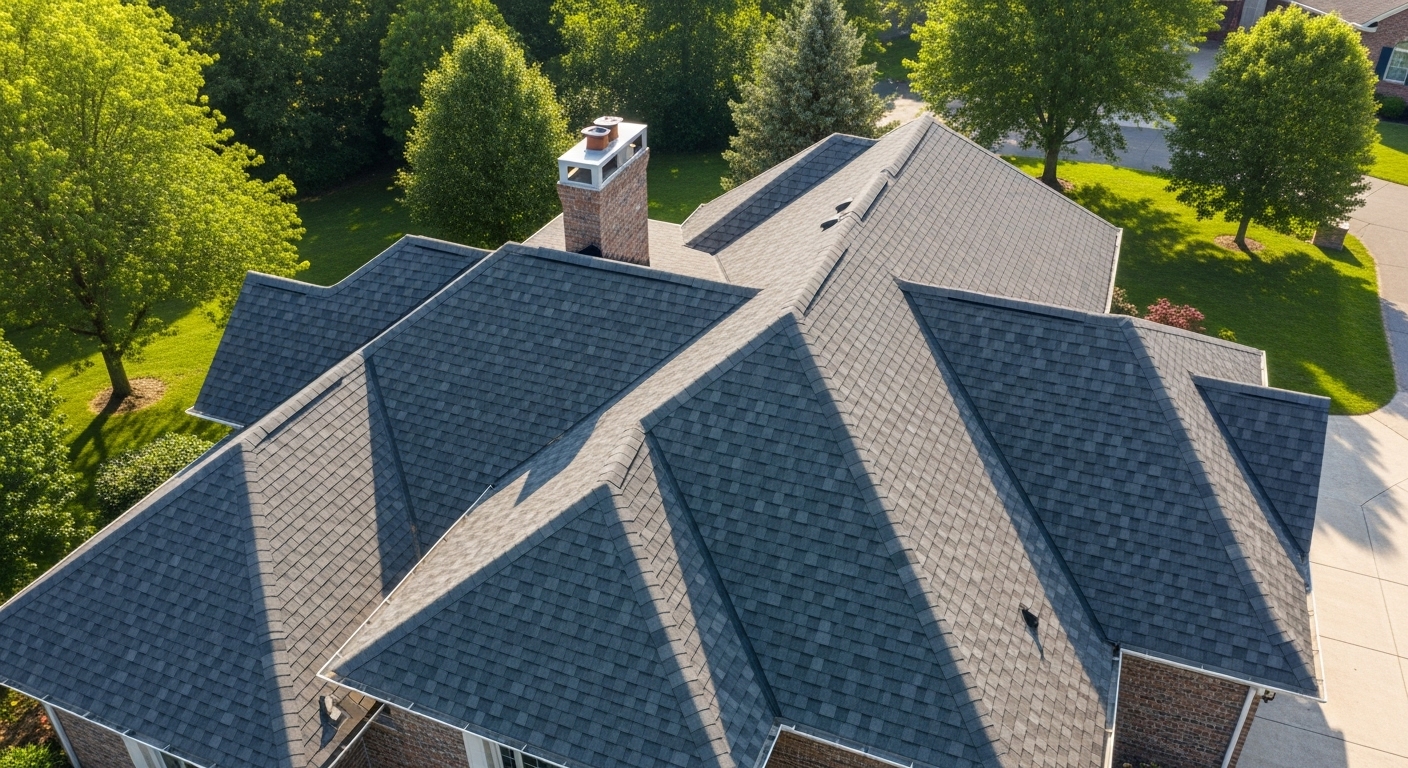
Stand back from the house. Not directly under the roof edge. Back far enough to see the pattern. Architectural shingles tend to look thicker and uneven, almost layered. The surface usually shows depth, shadows, and a kind of staggered texture that looks intentional, not random.
The purpose of any roof shingle is to help protect your home from the elements. It’s an added bonus if the shingle also delivers an aesthetic appeal that adds to the style of the home. This is one of the reasons behind the development of architectural shingles.
They were introduced to the market in the 1970s and ’80s to give homeowners a roof that created an architectural interest for the home and could also provide the higher-end look of genuine slate or natural cedar shakes without the added weight, costs, and maintenance.
https://www.gaf.com/en-us/blog/your-home/what-are-architectural-shingles-281474980182000
Three tab shingles look flatter. Cleaner lines. Repeating rectangles in a straight pattern. If your roof looks almost like graph paper from afar, that leans three tab. If it looks more like a layered surface with visual bumps and depth, architectural becomes more likely.
Check the shingle edges near the gutters
If you can safely look up at the roof edge near a gutter or drip edge, this helps a lot. Architectural shingles are thicker. Sometimes noticeably so. The edges may appear uneven, with layers stacked together. Some sections stick out slightly more than others.
Three tab shingles usually have a thin, flat edge. Very uniform. Almost boring, if roofs could be boring. No variation from one shingle to the next.
Look for shadow lines and depth changes
Architectural shingles are designed to cast shadows. That is part of the point. The layered construction creates darker and lighter areas even when the sun is high. This gives the roof a textured look, especially noticeable in the afternoon light.
Flat shingles do not really do this. Light hits them evenly. Shadows appear only at ridges or valleys, not across the field of the roof. If your roof looks almost two dimensional from most angles, it probably is.
Measure the shingle exposure if you can see it
Shingle exposure means how much of each shingle is visible once installed. Architectural shingles often have irregular exposure heights because of the layered design. The visible portion can vary slightly across the roof.
Three tab shingles almost always have the same exposure everywhere, usually around five inches. It is consistent to a fault. If everything lines up perfectly, that tells a story.
Age of the house can offer clues, not proof
Homes built before the early 2000s often came with three tab shingles as standard. Architectural shingles existed, but they were not the default. After the mid 2000s, architectural shingles became much more common in residential construction.
That said, roofs get replaced. A house built in 1995 could have architectural shingles now. A house built in 2015 could still have three tab if the builder cut corners. Age helps narrow things down, but it never gives a final answer.
Weight matters more than people think
Architectural shingles are heavier. They use more material and thicker asphalt layers. If you ever handled leftover shingles in the garage or attic, weight can be a clue. Architectural shingles feel solid and dense. Three tab shingles feel lighter, almost flexible by comparison.
This difference is one reason architectural shingles usually last longer. More material takes longer to break down. Simple physics, nothing fancy.
Look at the ridge caps if they match
Many roofs with architectural shingles use matching ridge cap shingles that are thicker and textured. They do not look like flat strips folded over the ridge. They look built, layered, and intentional.
Older three tab roofs often use cut up three tab shingles for ridge caps. These look thin and uniform. If the ridge looks chunky and dimensional, that points toward architectural.
Manufacturer markings can settle it fast
Sometimes the answer is printed right on the shingle wrapper, if you still have one. Leftover bundles in a garage often list the shingle type. Terms like dimensional, laminate, or architectural usually appear clearly.
If paperwork from a previous roof replacement exists, invoices often specify the shingle style. Contractors rarely leave that blank.
Why this difference actually matters
Architectural shingles usually last longer. Many carry ratings around 30 years or more, depending on conditions. Three tab shingles are often rated closer to 20 years. Wind resistance is also higher for architectural shingles. Some are rated for winds up to 130 mph when installed correctly.
Cost differences matter too. Architectural shingles typically cost more upfront, but not always dramatically more. Many homeowners end up surprised that the price gap is smaller than expected.
Final thoughts
You do not need to be a roofing expert to tell what you have. Look for thickness. Look for depth. Look for shadows. Flat, uniform, thin usually means three tab. Layered, textured, uneven usually means architectural.
If doubt still lingers, a roofer can confirm it in seconds during an inspection. Most of the time though, the roof itself gives away the answer if you give it a quiet, careful look.
